總網頁瀏覽量

顯示具有 Religion and Democracy 標籤的文章。 顯示所有文章

2023年6月10日 星期六

Break Down the Walls of Division


2023 Annual Member's Meeting 
Council For World Mission (CWM) 
Changhua Taiwan, June 10, 2023 
 Huang Po Ho 
 Director of Academy for Contextual Theologies in Taiwan

For he is our peace, who has made us both one, and has broken down the dividing wall of hostility (Eph. 2.14) 


Introduction 
Rev. Dr. Jooseop Keum, General Secretary of Council for World Mission, Distinguished delegations of CWM member Churches, guests and my dear Taiwanese colleagues: It is a great honor to be invited for this opportunity to talk to this annual member's meeting of CWM in my beloved home country of Taiwan. Many thanks to CWM family and general secretary Dr. Jooseop Keum for the invitation.The theme of this annual meeting is "Break Down the Walls of Division" which is taken from the Biblical passage in Paul's letter to the Ephesians (Eph. 2.14), where Paul had tried to convince the Ephesians that they were brought into the Christian community as equals and one with the Jews. And pointed out that this new status of the Gentiles was the fruit of the work of reconciliation through the crucifixion of Jesus Christ. 

This theme of "Break Down the Walls of Division" not only brings us back to the central message of the Christian faith, which the theologies of modern ecumenical movement derived from, it also timely reflects our critical contexts in the geopolitical tensions and the threats from the rivalry between two empires, that have forced the world to face a potential world war. The theme also reflects the nature of CWM as a missionary body and its commitment to "Oikomene". The very title of "Council for World Mission" shows the pioneering ecumenism of this group. It was changed from its original name "London Missionary Society (LMS)", a sending organization to evangelize the world, into a common fellowship of all missionary partners. Over the years, CWM has implemented many inspiring programs to combat empires and economic globalization, and to decolonize different sociopolitical hegemonic forces and irrelevant Christian mission. The theme thus is duly and urgent. 
 

The Wall to the Gentiles 

A key phrase in this passage which draws our attention is "Break down the dividing wall", this dividing wall has been further described as a "wall of hostility". A dividing wall is created by hostility. We have to be reminded here that the audients of this passage were the Ephesians Gentiles, who were the recipients of the letter and were treated hostile by the Jews. In the former verses, Paul had counting the inferior status of the Gentiles, he said: 

And you he made alive, when you were dead through the trespasses and sins in which you once walked, following the course of this world, following the prince of the power of the air... Therefore, remember that formerly you who are Gentiles by birth and called“uncircumcised" by those who call themselves "the circumcision” (which is done in the body by human hands) remember that at that time you were separate from Christ, excluded from citizenship in Israel and foreigners to the covenants of the promise, without hope and without God in the world. (2.1-2a,11-12) 

According to Paul's perception, gentile Ephesians status were inferior and contrast to that of the Jews:

 1) The Gentiles were called the uncircumcised by those who had claim to that of circumcision.         Here was the first of the great divisions. 
 2) The Gentiles had no hope of a Messiah; 
 3) The Gentiles were aliens from the society of Israel, and was not the holy people (ho hagios'         laos). 
4) The Gentiles were strangers from the covenants on which the promises were based. 
5) The Gentiles were without hope and without God in the world. 

It is to these downtrodden people of gentile Ephesians that Paul address on this topic of Break Down the Walls of Division. The gentile Ephesians were the one to be segregated by the wall of division, which was built by the self justified superior Jews. Ephesians did not have the ability and power to destroy barrier, yet they were granted the opportunity to cross over the wall to join the Messiah community. Paul was here to remind them the fact that their identity of being a Christian, was not attained through their human efforts or achievement by paying their own prices, nor by the grace from the oppressive Jewish party, But "have been brought near by the blood of Christ."

In another word, the message that Paul constructed in these sentences, are not a command nor an instruction for the Ephesians to take actions to break down the wall, instead, he points out that it is the intention of God, and reminded those who have being segregated outside the walls, that this has been realized through the graceful events of the crucifixion and resurrection of Jesus Christ.

The wall here that Paul pointed to was a symbolic expression of the curtain of the holy Temple, which was created by the Jewish community to segregate and preventing the Gentiles to approach closer to the holy sanctuary of the Temple. This curtain according to Paul was the dividing wall of hostility. he said: 

by abolishing in his flesh the law of commandments and ordinances, that he might create in himself one new man in place of the two, so making peace, and might reconcile us both to God in one body through the cross, thereby bringing the hostility to an end. And he came and preached peace to you who were far off and peace to those who were near; for through him we both have access in one Spirit to the Father. So then you are no longer strangers and sojourners, but you are fellow citizens with the saints and members of the household of God,

Accordingly, for Paul to Break down the wall was not the final purpose, instead the genuine purpose was to overcome discrimination and make peace between the Gentiles and the Jews, and to reconcile both of them to God. 

Walls Are Product of Human Spirituality 

2018年7月10日 星期二

詩巫之旅的迴響


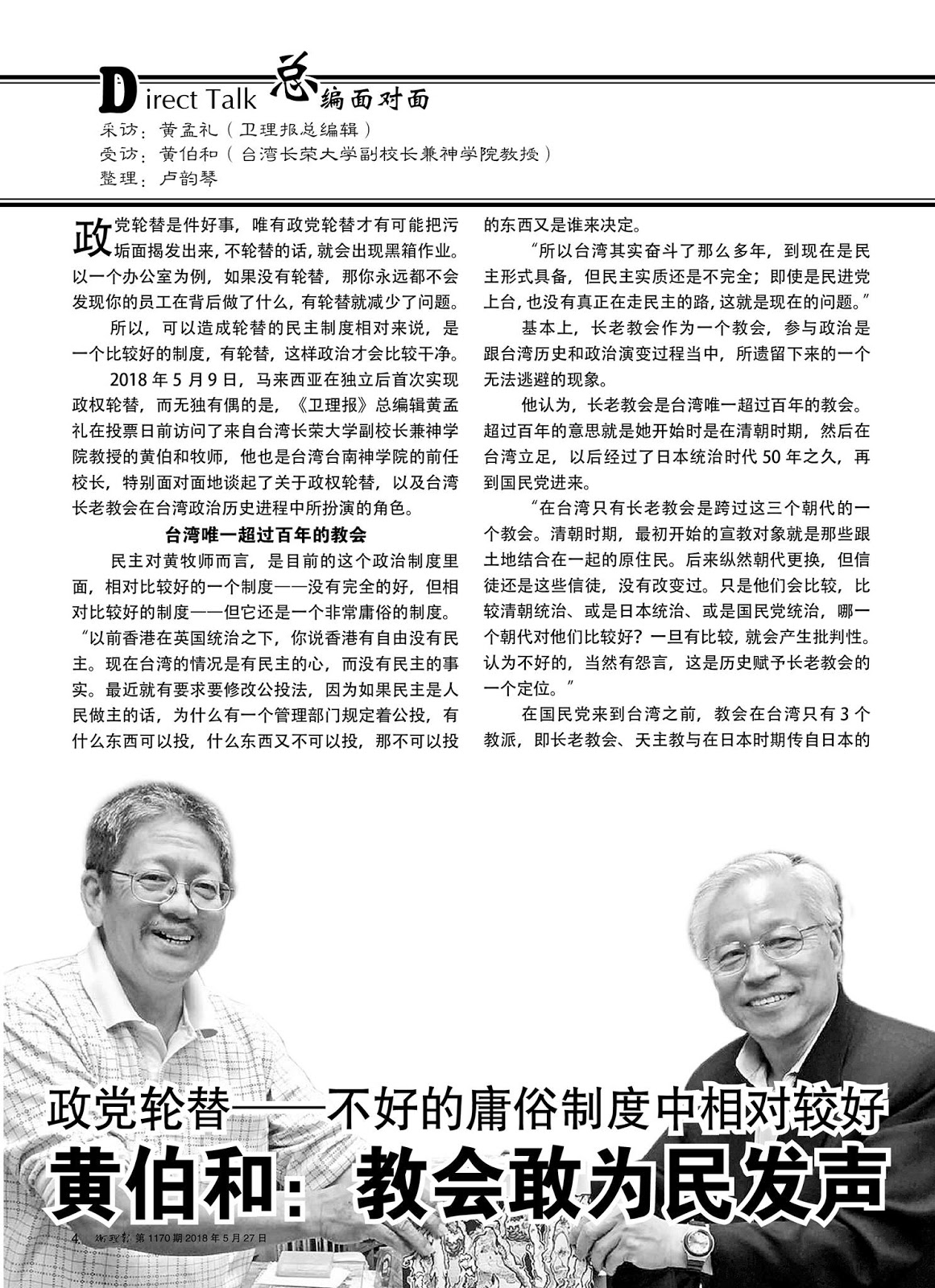
今年(2018)四月代表學校到東馬詩巫參加高等教育展,順便拜訪詩巫市長及馬來西亞衛理教會所屬的畢理學院,並與詩巫的教會牧長舉行了一個小型的座談會。在詩巫期間受到市長熱情的招待以及教會兄姐的多方關照。五天的停留市長家族所擁有的當地報紙每天都有長榮大學的大標題新聞。教會的衛理報並特別安排專訪,讓台灣與馬來西亞的教會經驗得以交流分享。一趟詩巫之旅溫情滿行囊。僅將衛理報專訪的兩篇訪問稿貼上分享:

2012年3月12日 星期一

被民主所 擄囚 的教會


【推介文】
PTHU Campus, Utrecht, The Netherlands
去年底應荷蘭抗議宗神學大學(Protestant Theological University)神學教授 Prof. Leo  Koffeman 的邀請,參與由他召集的一個跨國的執行委員會,共同籌備一個有關研究改革宗教會體制的國際研討會,並由長榮大學列名為台灣部分的合辦單位。研討會的名稱是「在變動處境中檢視改革宗的教會體制」。會議是在2011年11月7~10日假荷蘭的烏德勒支(Utrecht)抗議宗神學大學的校區舉行,與會者包括來自歐洲、美洲、非洲及亞洲的改革宗教會學者,並邀請幾位天主教及不同新教教派的學者一起參與討論。研討會中總共發表了近50篇論文,各從不同的教會處境探討改革宗體制在變動處境中所面對的問題以及改革之道。可以說匯集了世界改革宗教會精英對教會體制的一次全面性檢視。會議中對長老教會體制討論不多,主要集中在改革宗的部分,特別是延伸自多特會議(Council of Dordt)影響的教制運作。


The meeting venue of the Synod of Dordt
美國長老教會的約瑟夫‧斯摩爾教授(Joseph D. Small)在會議中發表了一篇論及美國長老教會最近有關議會制度運作的省思論文,深刻觸及長老教會制度運作與信仰形塑的緊張關係,對強調形式民主可能造成信仰扭曲與教會分裂的危險提出警示,個人覺得與我台灣基督長老教會所面對的問題相近,值得做為台灣教會的參考與反省,因此徵得約瑟夫教授的同意,帶回來給《台灣教會公報》翻譯發表,以饗讀者。(文/黃伯和,長榮大學專任教授)

被民主所 擄囚 的教會

作者 約瑟夫‧斯摩爾 翻譯 吳銘恩
( 連載於教會公報3129, 3130期)


synod of Dordt 1618-1619
美國長老教會(PC(USA))在2010年舉行的第219屆總會,通過3項戲劇性提案來修改其教會憲章:1.以嶄新的教會治理系統來替代舊的體制;2.廢止對未忠實履行「一男一女婚約或獨身守貞」者不予授職封牧的禁令;以及否決了3.在信仰告白篇中,納入以合一(unity)及反隔離(anti-segregation)為主旨的貝爾哈信仰告白(The Confession of Belhar)。美國長老教會憲章的修正,需要總會700多位委員的過半數票決,及全美173個中會的票決通過,始能成案。教制篇(The Book of Order)的修正,需要173個中會的過半通過;信仰告白篇(The Book of Confessions)的修正,則需獲得2/3以上中會的議決接納。

總會開議期間以468票贊成,204票反對的壓倒性票數認可新的治理體制(a new Form of Government)提案,經全體中會表決的結果,僅以52%的些微差距獲得通過。有關授職封牧標準的提案,則在正反票數上接近,分別是總會議決的373比273票,以及全體中會的56%比44%。是否接納貝爾哈信仰告白,雖在總會很輕易地過關,票數為525比150票,但是在全體中會的票決結果卻為62%比38%,無法獲得法定2/3中會的接納。這3個提案的正反票數逼近,暴露出美國長老教會內部的深刻分裂。

2010年11月26日 星期五

宗教與民主化: 社會系統理論觀點的檢視與重構


國立政治大學社會學系
劉育成博士論文發表會
指導教授: 顧忠華教授

評論人:黃伯和
2010年11月26日

前言:

首先恭喜劉育成先生在顧老師的指導下完成博士論文。
宗教與民主化的研究,尤其是以台灣基督長老教會與台灣民主化為題目的研究,過去已經有不少人作過。不過就我所閱讀過的有限文獻中,以盧曼的社會系統理論來檢視這一段長老教會與台灣民主化的過程,這篇論文應該算是一種新的嚐試。
盧曼的社會系統理論龐大而繁雜,很多學者都指出,要全然理解掌握盧曼的理論不是一件容易的工作。
不過就他嚐試以「功能分析」以及差異性之間的溝通,作為觀察社會演進的指涉,進而主張社會現象的「偶連性」特質,倒是提供我們一個動態、整全而富關聯性的角度來觀察、詮釋以及了解社會現象的可能。
劉先生的論文將盧曼的系統理論應用到七十年代以來台灣民主化過程中長老教會與台灣政局的互動與演變,有效的解構了傳統許多這方面的論述把長老教會對台灣民主化的貢獻視為既定的、理所當然的迷思,並向我們指出宗教與政治這兩個社會次系統內部各自多脈絡的分化、演變以及彼此之間的溝通、激擾(irritation),到形成改變之過程的複雜因素以及其結果的偶然性。我認為這是本論文很重要的一項貢獻。
劉先生的論文共分五章,除了第一章的導論外,第二章及第五章屬於對盧曼之社會系統理論的介紹以及重構和反省。有關長老教會與台灣民主化的論述主要分布在第三、四兩章。以下是我對這部分提出的三點看法來與劉先生討論並就教各位先進:
一)  多脈絡社會的多面向系統分化與演進中「長老教會的系統分析」
該論文在討論過台灣民主化過程中的長老教會與國民黨政府之互相激擾過程後,根據盧曼的系統理論點出:『民主化過程的啟動,以及民主化的穩定與深化,在很大程度上必須是宗教與政治系統分化的產物,其也是社會演化與系統分化之下的「偶然結果」(contingency). 』(p. 136)。
換句話說,台灣民主化之偶然結果是建立在各種次系統的內、外部分化,以及彼此差異性間的溝通、激擾演變而來的。這種分化、演進的次系統包括國民黨,當時的黨外以及台灣政治結構,當然也包括長老教會本身。
論文中對長老教會的內、外部分化與演進,似乎只局限在七十年代發表三個聲明期間(P.131)。對長老教會從一個「非政治的」(apolitical)宗教團體如何演變為對政治涉入的團體,其間發生的內、外系統的分化、激擾部分及其過程,論文中的陳述較少,或流於簡化(p. 132)。
論文中提到:「長老教會本身具有的民主性格,雖然在1970年代之前並未有明顯地行動以促進台灣民主的推動,但這並未磨滅其本身所具有的民主化潛力。」(p.134) 這樣的論述似乎過於樂觀,一方面加爾文本身在日內瓦改教期間實施的政治制度乃是幾近獨裁的神治體制,而非民主制度,另一方面長老教會制度的運作誠如論文所述,乃是貴族與平民政治的混合,也非民主體制(p.79)。
如果放大視野來做觀察,論文中提到的中華基督教長老會信友堂同屬長老宗信仰傳統,同樣處在同一時期的台灣政治氛圍,卻分化出全然不同的政治立場與取向,再加上觀察世界各地的長老教會(歸正教會)因地制宜的在各個不同國家處境中所展現的不同政治色彩,可以說很傳神的說明了盧曼系統理論與社會演化之【偶連性】主張。這部分或許論文可以加以擴延申論。
二)  差異與溝通的因果關聯
從第一點的觀察,我們不但得出台灣民主化進程是來自宗教與政治(以及其他系統)的分化、與差異溝通之「偶連性」的結果,換個角度,我們或許也可以說,長老教會之政治涉入與對台灣政治民主化之貢獻也是此一複雜之系統分化、演進過程的偶然產物。
從這一個角度切入,再根據盧曼的系統理論來看,論文中對長老教會之教義的強調與陳述(p.102, 128-129),也有過分樂觀的嫌疑。觀察長老教會對台灣政治的涉入過程,我們可以發現其動機鮮少是發自教義反省的催逼或指導,反而較多是來自經驗的溝通與激擾。教義的反省在這過程中扮演的比較是辯護與說明的,合理化教會行動之角色。
宏觀的看長老教會在台灣的演變,從初期一個以宣教師主導的「非政治」的教會,二次大戰後因緣際會藉著宣教師的被日本驅離,以及六十年代成功的倍加運動而啟動教會本土化的進程,教會領導階層與信徒人口組成的差異變化,改變了教會內部溝通的議題,同時轉變了其與外界(政治)溝通的立場與態度。七十年代三個聲明的陸續發表當然也透過內、外分化與激擾,使教會不斷修訂立場,甚至調整系統(如財團法人從集中制改為分散制)。
這些都讓我們必須重新省視,一個社會現象所牽涉的多元系統分化與互相衝擊的複雜範疇。同時這也挑戰我們再思差異溝通之過程中「上層結構」(Supra–structure) 與「下層結構」(Infra-structure)的不同角色與功能。論文中似乎太過樂觀的強調長老教會教義的主導功能,忽略了長老教會本身在此一系統分化過程中所經歷的改變與演進。甚至我們可以說其相關教義的的詮釋與再詮釋也是此一分化、溝通的結果。論文中對這部分的忽略,可能導致在論述過程中給人一個印象以為長老教會是台灣民主化的外在的、靜態的影響因素,而不是過程中互相激擾的系統之一。
三)  國是聲明的影響與偶然性
長老教會七十年代的三個涉入政治的信仰聲明與宣言,一直被認為是長老教會秉持信仰積極參與、推動台灣民主化的代表作。「對國是的聲明與建議」則被認為是打破禁忌,揭開民主化運動的序幕。不過從「對國事的聲明與建議」之發表過程(P.17),我們倒是可以看見其中所隱含的不確定性與被動性質。
根據周聯華牧師的口述,基督教聯合會決議在中華民國被排出聯合國,尼克森即將訪問中國之際,決定以聯合會的名義發表聲明呼籲台灣內部從事政治改革,以便因應國際變局。原本要以聯合會發表的聲明,卻因為有人通風報信,導致草擬聲明的代表接到政府當局的警告,而使合作破局,最終由長老教會取回草案經過修改以長老教會名義發表。
如果說「對國是的聲明與建議」是引發長老教會與國民黨政府的激烈對抗,並延續出後來兩個系統的分化、溝通與激擾,這個聲明卻不是長老教會有計劃的行動。假設聯合會中沒有通風報訊的事件,這份聲明果然以聯合會的名義發表,其中包括了當時總統的牧師,以及幾位在國民黨內位居重任的代表在內,這份聲明的衝擊性與後來由長老教會- -一個長期以來與國民政府處於緊張狀態的教會獨自發表,其意涵將不可同日而語。而且其內容也必不是目前所見的一般。
「對國是聲明與建議」的個案指是一個例子,以盧曼的系統理論來看,這個案例也可以推延到其他的事件上來探討。可見長老教會成為對台灣民主化有貢獻的宗教團體,其實也是在偶然性中透過系統的分殊與溝通逐漸演變而成的。

結語
綜合來講,此一論文應用盧曼的系統理論來重新觀察台灣民主化過程中,政治與宗教,特別是基督長老教會這兩個系統的分化、溝通與互相激擾,而達成台灣民主化的進程。這有助於我們對台灣民主化之社會現象從更整全的面向來認識與了解。這是此一論文的重要貢獻。同時,透過此一系統理論的運用,論文也向我們開展了各個次系統的分化、溝通與演變之探索的可能。祝福此一論文能順利通過,造福更多的學者。